

Picture a bakery a few blocks off the main strip. The bread is great, the coffee is better, and regulars swear by it. But new customers rarely find it, because when someone types “bakery near me” into Google, three other shops show up first, and this one doesn’t show up at all. That’s not a baking problem. It’s a local SEO problem.
Local SEO (short for local search engine optimization) is how your business gets found by people searching nearby, right when they’re ready to buy. For small and medium-sized businesses (SMEs), it’s one of the few marketing channels that compete with national brands on equal footing, because Google ranks local results by relevance and proximity, not by ad budget.
This guide walks through what local SEO actually involves, why it matters more in 2026 than it did a few years ago, and how to build a strategy that turns nearby searches into customers.
Quick answer
Local SEO improves your visibility in nearby search results by optimizing three things Google weighs most: relevance, distance, and prominence. A complete Google Business Profile (GBP), consistent business information across the web, local keywords, and a steady stream of reviews are the fastest ways to move the needle.
What local SEO actually means
Regular SEO focuses on ranking for a topic globally. Local SEO narrows that goal to a specific service area, so your business shows up when someone nearby searches for what you offer. That includes the “local pack” (the map with three highlighted businesses that appears above regular search results) and the standard organic listings below it.
Google evaluates local results using three main factors: relevance (how well your business matches what someone is searching for), distance (how close you are to the searcher or the area they specified), and prominence (how well-known and well-reviewed your business is, both online and off). Local SEO is the practice of strengthening all three.
The building blocks of a local SEO strategy
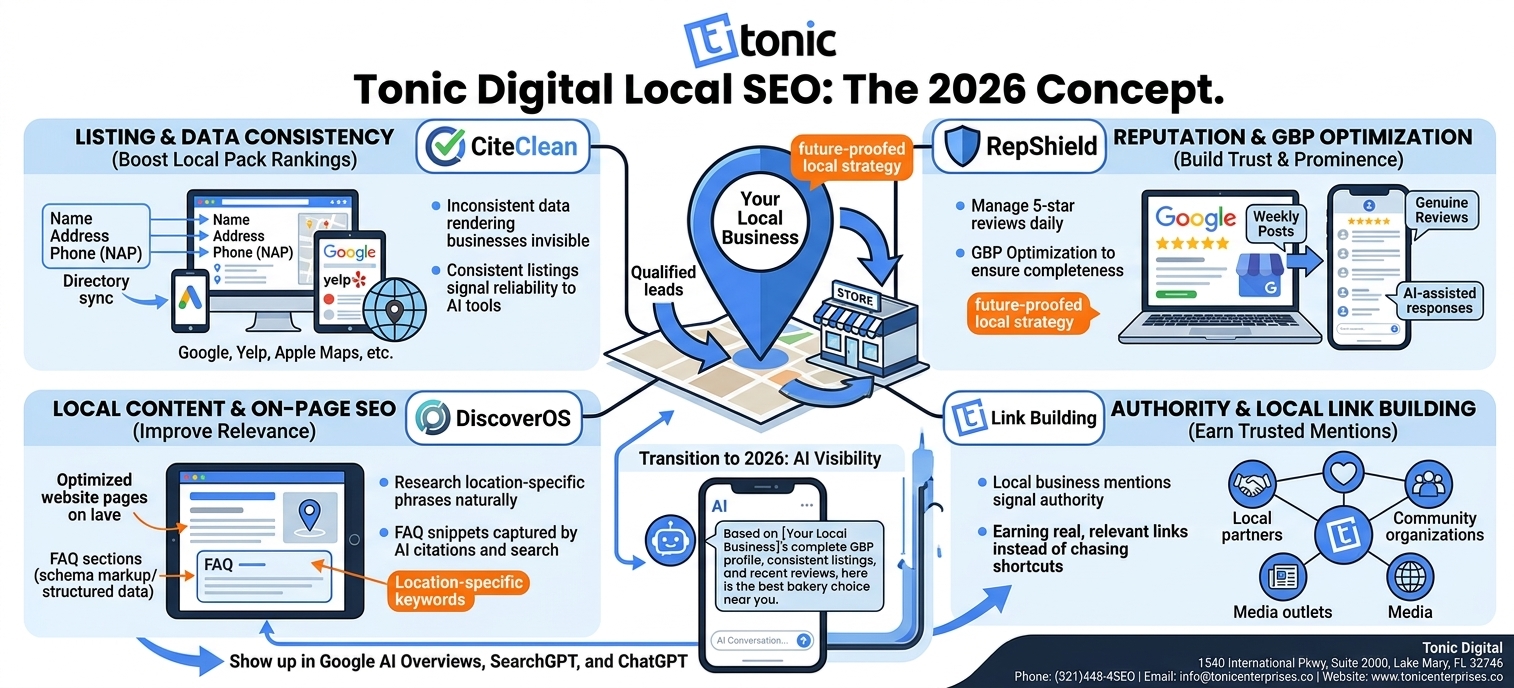
A complete Google Business Profile
Your Google Business Profile (GBP), the free listing Google shows for local searches, is the foundation upon which everything else is built. A profile with accurate hours, real photos, a full services list, and recent posts tells Google (and customers) that your business is active and legitimate. Businesses that skip this step are handing an easy win to competitors who don’t.
Local keyword research
General keywords like “plumber” are highly competitive and expensive to bid on. Local keywords, such as “emergency plumber in Lake Mary” or “plumber near me open now,” carry clearer intent and face far less competition. Working these phrases naturally into your website copy, page titles, and headings helps you show up for the searches that are most likely to convert.
Consistent business information (NAP)
NAP stands for name, address, and phone number. When these details match exactly across your website, GBP listing, and directories like Yelp or Apple Maps, Google trusts your business information more and ranks it accordingly. Mismatched addresses or old phone numbers scattered across the web quietly work against you.
Reviews and reputation
Reviews influence rankings and purchase decisions simultaneously. A steady flow of recent, genuine reviews, along with thoughtful responses to both the good and the bad ones, signals prominence to Google and builds trust with the person reading them before they’ve even called you.
“Local SEO doesn’t need a big budget. It needs consistency, and most of your competitors aren’t putting in the work.”
Local link building
Getting linked to from other local businesses, community organizations, and industry directories signals to Google that you’re a real, established part of the area. Sponsoring a local event, partnering with a nearby business, or getting listed in a chamber of commerce directory all count, and they build the kind of authority that’s difficult for competitors to copy.
How to get started with local SEO
Claim and complete your GBP listing. Verify ownership, then fill in every field: hours, categories, services, and photos. An incomplete profile is a missed opportunity sitting in plain sight.
Audit your NAP consistency. Search your business name and check that your listed address and phone number match everywhere they appear online. Fix mismatches as you find them.
Add local keywords to your website. Work location-specific phrases naturally into your homepage, service pages, and page titles. Don’t force it; write for the person who will read it first.
Build a review habit. Ask satisfied customers for reviews right after a good experience, and respond to every review you get, positive or negative.
Earn a few local links. Start with directories, chambers of commerce, and any local partners you already work with.
Track and adjust. Local SEO isn’t a one-time setup. Watch which searches bring in customers and keep refining from there.
Local search is changing again in 2026
More local searches now start within AI tools like Google’s AI Overviews, ChatGPT, and Perplexity, rather than on a traditional search results page. These tools pull from the same signals that power local SEO, meaning a strong GBP profile, consistent NAP data, and genuine reviews aren’t just helping you rank anymore. They’re what determine whether an AI assistant recommends your business at all when someone asks it for a nearby option.
In other words, the fundamentals haven’t changed, but the stakes have. Businesses with clean, complete, and consistent local data are showing up in more places than ever. Businesses without it are becoming harder to find, in search and in AI answers alike.
Where a digital marketing agency fits in
Local SEO works, but it’s not a set-it-and-forget-it project. Rankings shift, competitors catch up, and Google adjusts what it rewards. Staying ahead takes ongoing attention that’s easy to lose in the day-to-day of running a business.
At Tonic Digital, this is the work our managed SEO services handle end-to-end: building out your GBP profile, cleaning up NAP consistency across the web, and monitoring rankings so you don’t have to. For businesses that want to show up in AI-driven search, our AI visibility services extend that same foundation to AI Overviews, ChatGPT, and Perplexity. And when it’s time to build the kind of local authority that search engines reward, our link building services earn real, relevant links instead of chasing shortcuts that put your domain at risk.
If you’re not sure how your local SEO is performing right now, that’s a quick thing to find out.
Ready to show up for nearby searches?
Let’s find out what’s holding your local rankings back and fix it.
Contact Tonic Digital
Founder of Tonic Digital, a digital marketing agency in Lake Mary, FL, helping small and mid-sized businesses grow through SEO, AI search visibility, and local search strategy.
Related Tonic Digital services
Tonic Digital
1540 International Pkwy, Suite 2000, Lake Mary, FL 32746
Phone: (321) 448-4SEO • Email: info@tonicenterprises.co
Website: www.tonicenterprises.co