

If you’ve been running a strategy that puts your content on someone else’s high-authority website so it ranks on their domain’s reputation, Google has a name for that now, and it’s not a compliment. A late-August 2026 rewrite of Google’s site reputation abuse policy made enforcement sharper, not softer, and it landed the same month as a spam update that shook up rankings across the board. And if your business serves customers in the United States, nothing about this picture has changed in your favor.
Here’s what actually happened, what Google’s reviewers now look for, and why the businesses that come out ahead are the ones building authority on their own domain instead of renting it from someone else’s.
Quick answer
Parasite SEO, publishing content on a third-party site to borrow its ranking signals, is what Google’s site reputation abuse policy targets. After Google rewrote that policy in late August 2026, enforcement is more specific. Outside the European Economic Area (EEA), the penalty is unchanged: a manual action that demotes your pages. The safer long-term play is earning editorial links that send authority back to a domain you actually own.
What is parasite SEO, and why does Google care?
Parasite SEO is the practice of publishing your content on an established third-party website, a metro newspaper, a university page, a big media brand, specifically so those pages inherit that site’s ranking strength rather than earning their own. A casino roundup on a medical site. A CBD affiliate article buried in a business publication with no author. A coupon subfolder on a news site that was never disclosed to readers. The page ranks not because it’s good, but because Google initially presumes that a new page on a strong domain is roughly as trustworthy as the rest of that domain.
Google first named this as a policy violation alongside the March 2024 core update and started enforcing it in May 2024. For two years the policy text was short, and a handful of examples carried most of the explanatory weight. In August 2026, a new, much longer version of the policy changed the situation meaningfully.
What the August 2026 spam update did (and didn’t) do
The update ran from August 18 to August 21 and applied globally, across all languages. Google described it on its status dashboard as a standard spam update with no named target tactic. But third-party ranking data told a different story. SE Ranking tracked 100,000 U.S. keywords across 20 industries and found that 16.71% of URLs in the top 10 fell past position 100 during that four-day window, compared to 9.2% in a quiet baseline period. That’s roughly an 82% jump in the rate at which top-10 pages simply disappeared from the first few pages of results.
One important detail: Google said this update did not target site reputation abuse, which is handled by a separate system. So a drop between August 18 and 21 doesn’t by itself mean a hosted page got caught. What the update does show is how fast rankings can move when Google tightens up, and pages that lean on borrowed authority have the least to fall back on.
What Google’s rewritten policy actually says
The late-August policy rewrite is much longer than the previous version, and it introduced something the old text lacked: a formal framework for how a human reviewer decides whether hosted content is legitimate or parasitic.
The key distinction is intent. Third-party content by itself is not a violation. It only becomes one when that content exists on a domain mainly to borrow ranking signals, rather than to serve that site’s readers. Google trimmed the examples list, added a disclaimer that the list isn’t exhaustive, and spelled out the four factors its reviewers weigh.
“A page you rented on someone else’s domain is not an asset. The authority stays with the host, and the loan gets called the moment Google looks closely.”
The four factors Google reviewers look at
When a portion of a site is flagged, Google’s stated goal is to determine whether the content has enough editorial oversight, host involvement, or site integration to be considered genuinely part of that domain. The four factors they weigh are:
Presentation. Does the content look and feel like the rest of the host site? Different fonts, layouts, or formatting that suggest the content was dropped in from somewhere else are a signal it doesn’t belong there organically.
Quality. Are there quality problems on these pages that don’t appear on the rest of the site? Thin content, missing citations, and no expert voice on a domain that usually has all three is a red flag.
Authorship. Is there a clear statement of who created the content and who is editorially responsible for it? Missing or contradictory authorship signals gets noticed.
Duplication. Does identical or near-identical content appear on several other sites? Content that was produced for mass distribution and seeded across domains is exactly what Google is looking for here.
Google was explicit that no single factor decides the outcome, and reviewers can also weigh outside evidence, including whether the pages are being sold as part of a third-party ranking package. That last clause is aimed at the sponsored-post marketplaces that built a business around parasite placements.
What about the EEA exemption? Is that a loophole?
On August 28, Google announced it would stop applying site reputation manual actions for searchers inside the European Economic Area, effective August 30. Some people read this as a green light to keep running parasite strategies. It isn’t, for two reasons.
First, inside the EEA, Google doesn’t demote the pages but it may categorize them as separate from the host domain, meaning they have to rank on their own merits instead of borrowing the host’s authority. That is the exact mechanism parasite SEO depends on. Removing it, even without a penalty, makes the tactic pointless in that region.
Second, if your customers are in the U.S., or anywhere else outside the EEA, the original penalty is unchanged. A manual action still demotes your pages in those results, and the two regions are walled off from each other. One region’s treatment doesn’t carry over. For most businesses operating in the American market, the EEA carve-out is simply not relevant.
What to do if you’ve been relying on hosted content
If any part of your current strategy involves paying for or arranging content on third-party domains to target keywords, here’s a practical audit you can run right now:
List every off-domain page you’re paying for. Include sponsored posts, partner sections, guest posts on link-selling marketplaces, and any white-label placement where your keyword is the target, not the host’s audience.
Score each one against the four factors. Different presentation, thin quality, missing author credit, or content appearing on multiple sites: two or more of those flags means you should assume Google will see the problem the same way you do.
Check where those pages rank today. Search the keywords each hosted page was built to target and note whether it still shows up. A hosted page that has slipped out of the results is a liability, not an asset.
Bring the good content home. If a hosted article is genuinely strong, republish an expanded version on your own site and ask the host to link to it. You keep the content and convert a liability into a real backlink.
Reallocate the budget toward placements that send authority to you. Editorial links, digital PR, and outreach to real publishers cost about the same as parasite placements but build an asset you actually own.
The real alternative: editorial link building that compounds
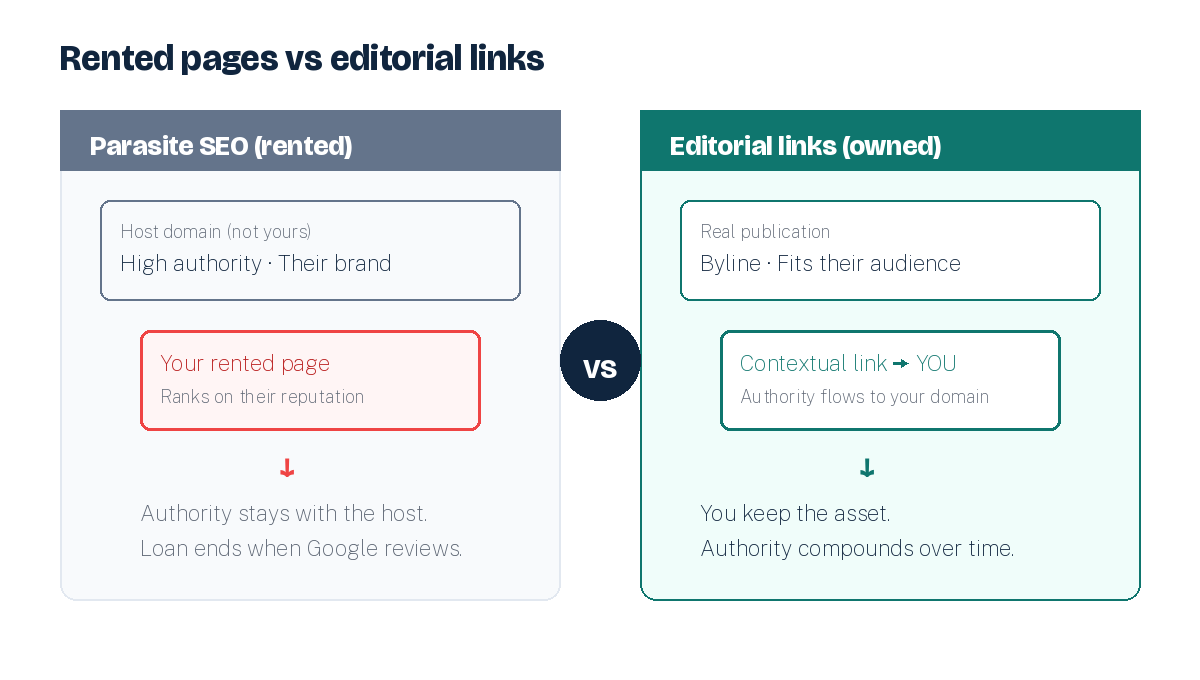
The difference between a parasite placement and a legitimate editorial placement comes down to one question: where does the authority end up? With a parasite page, authority stays with the host and disappears when the host gets reviewed. With an editorial placement, a real article about your business runs on a real site, with a byline, a contextual link, and a structure that fits the publication. The authority flows back to your domain and compounds month after month.
At Tonic Enterprises, our link building service is built around exactly this model: editorial placements on vetted, real-traffic publications, written to fit the host’s audience, with the link and the trust signal pointing back at your site. It’s also the kind of citation density that AI Overviews and large language models now weigh when deciding which brands to surface in answers. That matters more each month as search behavior shifts.
If you’ve been relying on hosted content to hold rankings and want to understand what a cleaner off-page SEO strategy would look like for your business, we’re happy to walk through it. No jargon, just a clear picture of where you stand and what the path forward looks like.
Stop renting authority. Start building it.
Let’s look at your current link profile and build a strategy that grows your domain, not someone else’s.
Talk to Tonic Enterprises
Founder of Tonic Enterprises, a digital marketing agency in Lake Mary, FL helping small and mid-sized businesses grow through SEO, AI search visibility, and link building that builds real authority.
Related Tonic Enterprises services